⭐ Puranic Significance (ध्रुव चरित्र - श्रीमद्भागवतम)
The story of Bhakta Dhruva from Srimad Bhagavatam (Canto 4) and Vishnu Purana illustrates unwavering willpower (Dridha Sankalpa), supreme devotion, and how a five-year-old child attained the darshan of Bhagwan Vishnu and immortal position as the Pole Star (Dhruva Nakshatra).
All of us are aware of the Pole Star; it is positioned directly above the North Pole, a steadfast and luminous beacon that remains constant in its celestial abode when viewed from any point on earth. For uncounted generations, it has guided voyagers, seafarers, and desert travelers across perilous journeys, and even in modern astronomy, it serves as an indispensable reference point. In sacred Indian tradition, this eternal sentinel of the heavens is venerated as Dhruva Nakshatra or the Dhruva Tara.
Dhruva was born into the celebrated lineage of Svayambhuva Manu as the son of King Uttanapada. The king had two wives: Suniti, the elder queen of profound virtue and noble character, and Suruchi (also called Sumati), the younger wife who possessed remarkable physical beauty and held the infatuated king firmly under her sway. Though Queen Suniti was entitled to royal honours, she bore no child for many long years. Meanwhile, Suruchi gave birth to a prince named Uttama, which made her arrogant and envious of Queen Suniti.
Fearing that if Queen Suniti ever gave birth to a son, her own child Uttama might be superseded as heir to the throne, Suruchi used her influence over the king to banish Queen Suniti to a modest hermitage on the outskirts of the forest. In that tranquil exile, Suniti gave birth to a radiant and noble child whom she lovingly named Dhruva. Dhruva grew amidst the pristine wonders of nature, nurtured on sacred tales of dharma, righteousness, and devotion by his saintly mother and passing sages.
When Dhruva attained the age of five, seeing other children speak of their fathers, he expressed a yearning to see King Uttanapada. Dressed in modest attire and with his mother's loving blessing, the child journeyed to the royal court. Seeing his innocent son, King Uttanapada was moved with fatherly love and warmly embraced Dhruva, seating him upon his royal lap.
Watching this, Queen Suruchi rushed forward in fury, violently dragged little Dhruva from his father’s lap, and seated her own son Uttama there instead. She rebuked the child harshly, declaring that only a son born of her womb had the right to sit upon the king's throne or in his lap, and mocked him to seek the grace of Lord Hari through penance if he ever desired royal honour. The king, blinded by infatuation, uttered not a single word in defense of his innocent son.
Deeply grieved yet composed, the little prince touched the feet of his father and Queen Suruchi, and returned weeping to his mother in the forest. When Queen Suniti learned of his anguish, tears welled in her eyes, but she imparted the highest spiritual truth: "My child, do not harbour resentment towards anyone. Your stepmother speaks the truth—only the Lotus-eyed Bhagwan Sri Hari Vishnu is the supreme sovereign of all realms. Seek His lotus feet, for He who sustains the universe grants an eternal kingdom that no mortal can ever take away."
Imbued with resolute determination, child Dhruva resolved to find Lord Vishnu. While his mother slept, he prayed silently for her protection and slipped into the deep, dark forests of Madhuvana on the banks of the sacred Yamuna. Wild beasts, thorny brambles, and towering trees surrounded him, but his fearless heart knew only one quest: to find the Lotus-eyed Lord.
Moved by the child's astonishing resolve, the celestial sage Devarshi Narada appeared before him to test his sincerity. Narada cautioned Dhruva about the perils of the forest and urged him to return to play, telling him that severe penance was meant for seasoned ascetics, not tender boys. But Dhruva bowed humbly and said: "O holy sage, the words of humiliation have pierced my heart like arrows. My resolve is immovable. If you truly pity me, kindly reveal the true path to behold Bhagwan Vishnu."
Sage Narada initiated Dhruva into this supreme twelve-syllable mantra and instructed him to perform austerities in the sacred groves of Madhuvana, meditating steadfastly upon the transcendental four-armed form of Lord Vishnu.
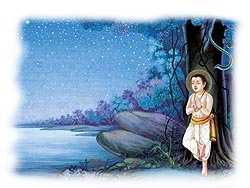
In the sacred groves of Madhuvana, Dhruva sat in firm Padmasana (lotus posture) and commenced his extraordinary tapasya. In the first month, he ate only wild fruits every third day; in the second month, dried leaves every sixth day; in the third month, water only once in nine days; in the fourth month, only air every twelfth day; and by the fifth month, standing on one leg like an immovable pillar, he suspended his breath and focused his entire mind exclusively upon the Supreme Lord in his heart.
The intensity of the child’s spiritual energy caused the three worlds to tremble, and the deities prayed to Lord Vishnu to intervene. Bhagwan Vishnu, overwhelmed by the pure devotion of His young devotee, appeared before Dhruva in His magnificent four-armed form holding the Conch (Shankha), Discus (Chakra), Mace (Gada), and Lotus (Padma).
Opening his eyes, Dhruva saw the Lord standing before him in living glory. Speechless with reverence, the young child folded his hands. Sensing Dhruva's desire to praise Him, the all-merciful Lord gently touched the boy's cheek with His divine Conch, Panchajanya, instantly awakening within Dhruva all transcendental Vedic knowledge and poetic wisdom. Dhruva then recited the sublime hymn known throughout the scriptures as the Dhruva Stuti.
Pleasant with his selfless love, Lord Vishnu bestowed upon him the highest sovereignty on earth for thirty-six thousand years, and thereafter granted him an immortal dwelling place in the highest realm—the Dhruva Loka (Pole Star)—around which all planetary constellations, stars, and Saptarshis (the Seven Sages) revolve eternally until the end of the cosmic kalpa.